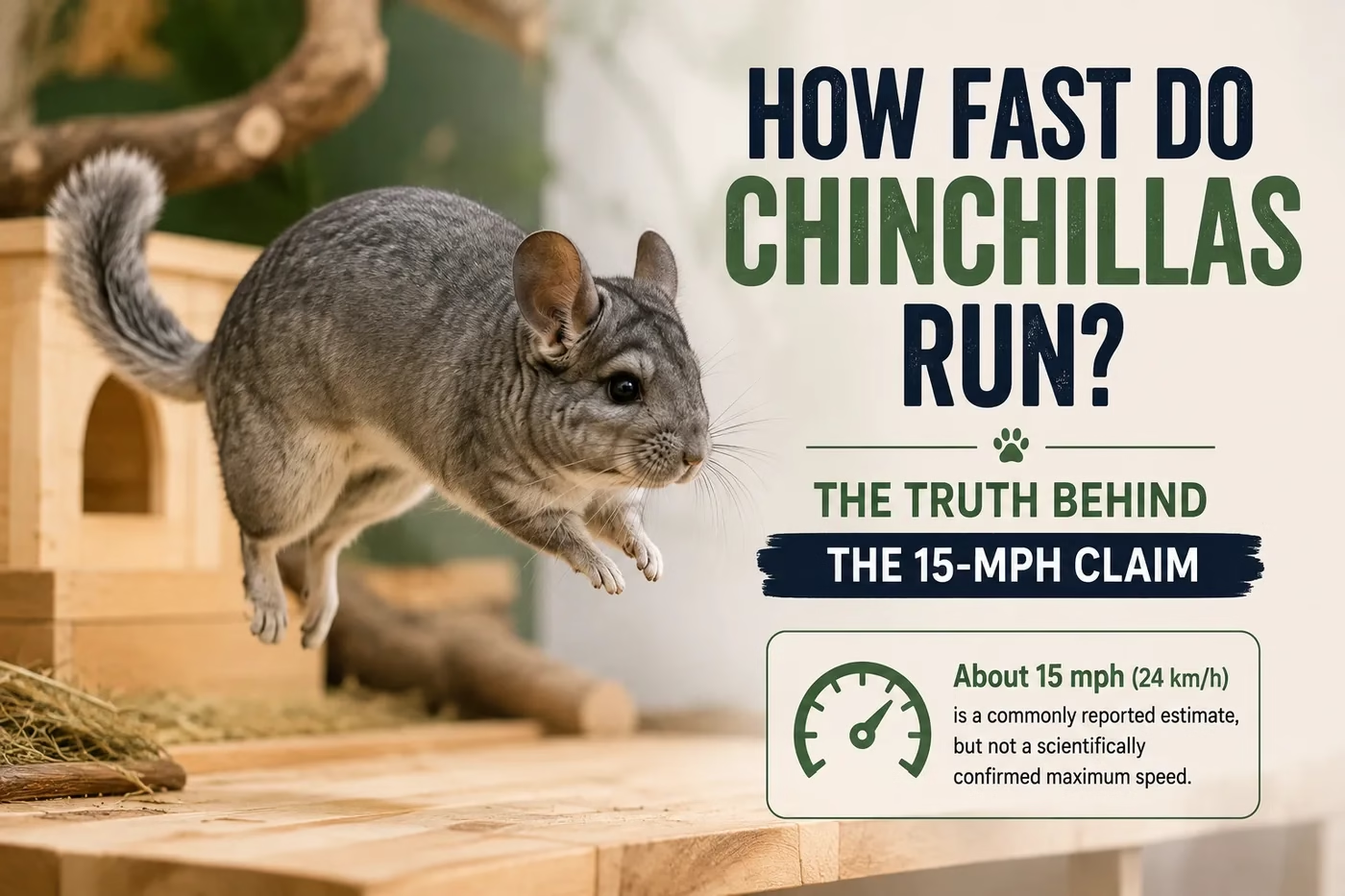
Chinchillas are surprisingly agile animals. You may have seen websites claim that a chinchilla can run at 15 mph (24 km/h). That number is widely repeated online, but there’s an important catch: we couldn’t verify a primary scientific study that actually measured 15 mph as a chinchilla’s maximum running speed. Some animal-information sites list 15 mph while simultaneously acknowledging that the speed has not been directly measured.
What scientific research does show is that Chinchilla lanigera has specialized locomotion and that chinchillas are active animals that spend a meaningful portion of their day moving around.
So how fast can a chinchilla really run? Let’s separate the commonly repeated number from what the research actually tells us.
Quick Answer
About 15 mph (24 km/h) is a commonly reported estimate for chinchilla running speed, but it should not be presented as a scientifically confirmed maximum.
The research we could verify provides evidence about chinchilla locomotion, activity, and welfare, but not a controlled measurement establishing a 15-mph top speed.
That’s an important distinction.
Is 15 mph Really a Chinchilla’s Maximum Speed?
The 15-mph figure appears repeatedly across animal-information websites, but repetition isn’t the same thing as experimental evidence.
For example, some animal-reference pages list a top speed of 15 mph while also noting that chinchilla speed has not been measured.
We found scientific research examining chinchilla locomotion and behavior, but the papers we could verify do not establish 15 mph as a measured maximum.
For that reason, ChinchillaNook treats 15 mph as a commonly reported estimate, not as a scientifically confirmed top speed.
ChinchillaNook Evidence Check
| Claim | Evidence |
|---|---|
| Chinchillas have specialized locomotion | 🟢 Strong |
| Chinchillas perform substantial locomotion | 🟢 Strong |
| Chinchilla locomotion has been scientifically studied | 🟢 Strong |
| Chinchilla lanigera is specialized for a half-bounding gait | 🟢 Strong |
| About 15 mph is commonly reported online | 🟡 Widely reported |
| 15 mph is a scientifically established maximum | 🔴 Not established by the research we could verify |
| Chinchillas reach 15 mph within a specific number of seconds | 🔴 Not established |
Our approach: when a precise number cannot be traced to a reliable measurement, we’d rather explain the uncertainty than present the number as established fact.
How Do Chinchillas Move?
One of the most interesting things about chinchillas isn’t simply how fast they can run.
It’s how they move.
A study published in the Journal of Zoology examined the development of the locomotor skeleton in Chinchilla lanigera and Oryctolagus cuniculus and compared them with species that are not specialized for half-bounding.
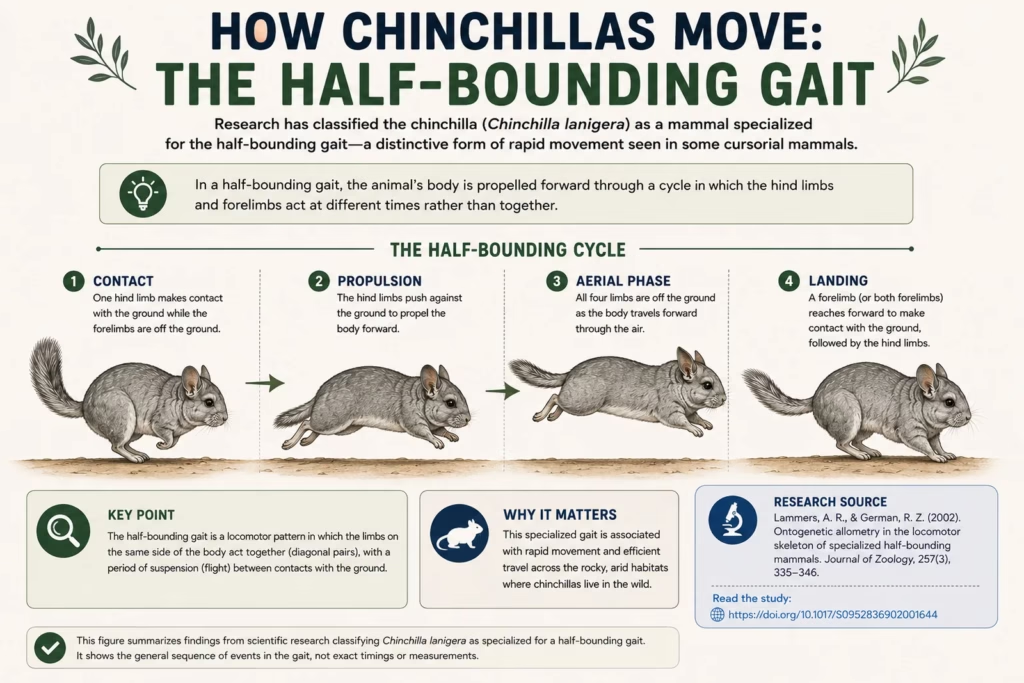
The researchers classified Chinchilla lanigera as one of the mammals specialized for the half-bounding gait.
Research: Lammers & German, Journal of Zoology (2002).
The paper is primarily a study of locomotor-skeleton development and allometry. It does not provide a measurement of how many miles per hour a chinchilla can run.
That’s worth pointing out because it’s easy to take a legitimate scientific paper about locomotion and turn it into a claim that the researchers never actually made.
What Is a Half-Bounding Gait?
A half-bound is a form of quadrupedal locomotion in which the limbs on the same side of the body can move in a coordinated pattern, producing a bounding-style movement with periods when the animal is airborne.
The important point for chinchilla owners is not memorizing the biomechanics.
It’s understanding that chinchilla movement is specialized and distinctive, rather than simply being ordinary running scaled down to a tiny animal.
The 2002 study specifically investigated chinchillas as specialized half-bounders and examined how their limb bones develop in relation to this locomotor specialization.
ChinchillaNook note: our illustration of the half-bounding cycle is a simplified educational diagram. It is not a frame-by-frame reconstruction of a measured chinchilla stride.
How Active Are Chinchillas?
This is where we have much stronger quantitative evidence than we do for maximum running speed.
A 2023 study published in Scientific Reports followed 12 adult female farmed chinchillas. The researchers used round-the-clock video recordings to create behavioral records while the animals were housed in three different cage types.
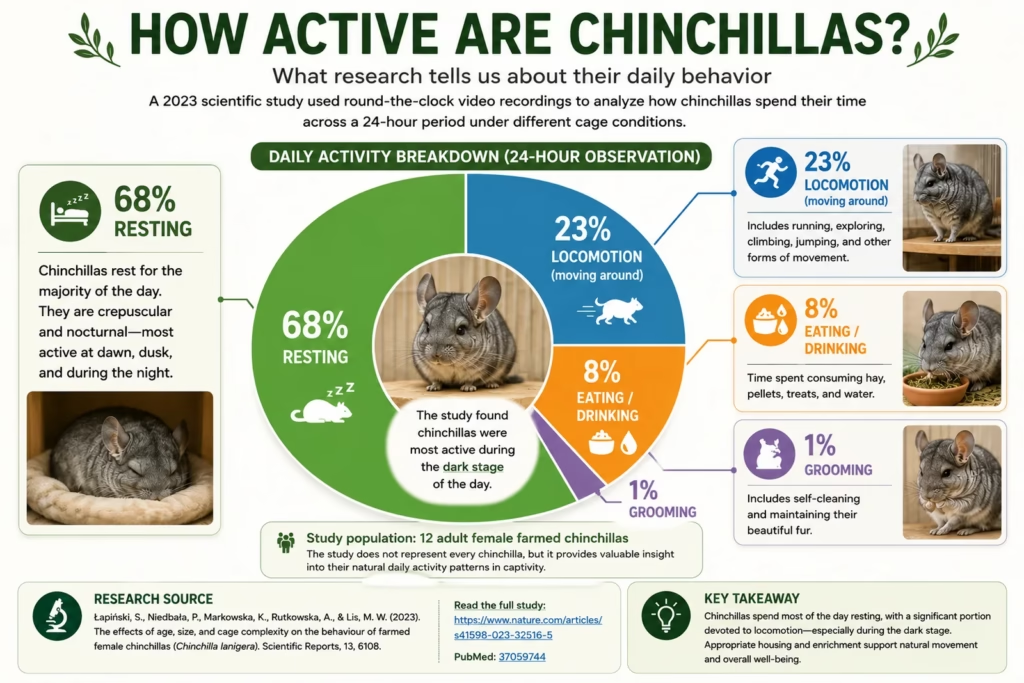
Across the observations, the chinchillas spent approximately:
- 68% of the day resting
- 23% in locomotion
- 8% eating or drinking
- 1% grooming
The researchers also found that the animals were mostly active during the dark stage of the day.
What about cage enrichment?
This part needs some nuance.
Compared with the standard cage, chinchillas in the enriched standard and enlarged/enriched cages spent more time in extensive locomotion and less time resting. The study also found that larger cage size and enrichment—particularly litter—were associated with reduced fearfulness toward humans.
However, the researchers also reported that there was no significant difference in the overall distribution of time spent in each form of activity across the cage types.
So we shouldn’t simplify the result to:
“Bigger cages cause chinchillas to exercise more.”
A more accurate conclusion is:
The study observed more extensive locomotion in the enriched and larger cage environments, while overall activity-time distributions did not differ significantly between cage types.
That’s a much more useful—and scientifically honest—interpretation.
Read the full 2023 Scientific Reports study →
Running Isn’t the Only Impressive Thing Chinchillas Do
When someone asks, “How fast can a chinchilla run?”, they’re usually imagining a tiny animal sprinting across a floor.
But speed is only one part of the picture.
Chinchillas also need opportunities for:
Jumping and climbing
Veterinary guidance recommends large cages with multiple levels, ramps, and places to climb because chinchillas are very active animals.
Exploring
The 2023 behavioral study documented locomotion and other behaviors under different housing conditions.
Exercise
The Merck Veterinary Manual recommends daily exercise and describes a 15-inch running wheel with a smooth surface as an exercise option. It warns against wheels with holes or rough surfaces because they can injure a chinchilla’s feet or legs.
Read Merck Veterinary Manual’s chinchilla exercise guidance →
So rather than thinking of a chinchilla simply as a “fast rodent,” it is more accurate to think of it as a small, active animal with specialized locomotion and a strong need for opportunities to move and explore.
Do Pet Chinchillas Need Exercise?
Yes.
Exercise isn’t about making your chinchilla reach its maximum possible speed. It’s about providing safe opportunities for normal movement and activity.
The Merck Veterinary Manual says chinchillas need daily exercise and recommends a large cage with toys. It also recommends supervised playtime in a chinchilla-proof room.
A suitable exercise environment can include:
- A properly sized smooth-surface running wheel
- Multiple safe levels
- Climbing opportunities
- Chew-safe toys
- Supervised play outside the cage
- A secure, chinchilla-proof room
Merck specifically warns against plastic exercise balls because they can be too small and can roll into objects, potentially causing injury.
See the full Merck Veterinary Manual guidance →
What Does the Research Actually Tell Us About Chinchilla Speed?
Here’s the simplest way to understand the evidence.
What we know
🟢 Chinchilla lanigera has specialized locomotion associated with the half-bounding gait.
🟢 Chinchilla activity and locomotion have been studied experimentally.
🟢 In one study of 12 adult female farmed chinchillas, locomotion accounted for about 23% of the observed day.
🟢 Chinchillas are active animals that benefit from opportunities for exercise and movement.
What we don’t know with the same confidence
🟡 15 mph is widely reported online.
🔴 We could not verify a primary scientific experiment establishing 15 mph as the maximum running speed of a chinchilla.
🔴 We could not verify a reliable measurement showing how quickly a chinchilla accelerates to 15 mph.
🔴 We should not present an exact maximum speed as fact simply because many websites repeat the same number.
This is why ChinchillaNook uses an evidence-first approach.
How Fast Is a Chinchilla Compared With Other Animals?
Be careful with animal speed comparison charts.
You may find websites comparing chinchillas with rabbits, hamsters, guinea pigs, cats, or other animals. But maximum-speed figures aren’t always measured using the same methods, and some animal speeds are themselves estimates.
Comparing those numbers can therefore create a false sense of scientific precision.
For now, the more useful takeaway is:
Chinchillas are remarkably agile for their size, but we don’t have strong evidence for an exact maximum running speed.
Frequently Asked Questions
How fast can a chinchilla run?
About 15 mph (24 km/h) is a commonly reported estimate, but we could not verify a primary scientific measurement establishing that figure as a chinchilla’s maximum speed.
Is 15 mph the confirmed top speed of a chinchilla?
No. The figure is widely reported online, but the scientific research we could verify does not establish 15 mph as a measured maximum.
Why are chinchillas so agile?
Their locomotion has distinctive biomechanical characteristics, and Chinchilla lanigera has been studied as a species specialized for the half-bounding gait.
Do chinchillas need daily exercise?
Yes. The Merck Veterinary Manual recommends daily exercise and supervised play in a chinchilla-proof environment.
Can chinchillas use exercise wheels?
Yes. Merck recommends a 15-inch running wheel with a smooth surface and warns against wheels with holes or rough surfaces.
When are chinchillas most active?
In the 2023 study of 12 female farmed chinchillas, the animals were mostly active during the dark stage of the day.
The Bottom Line
15 mph is the number you’ll commonly see quoted for chinchilla running speed, but it should be treated as a commonly reported estimate—not a scientifically confirmed maximum.
The research gives us something more useful than a single number.
Chinchillas have specialized locomotion, and behavioral research shows that movement is a meaningful part of their daily activity. Veterinary guidance also emphasizes daily exercise, climbing opportunities, enrichment, and safe supervised play.
So if your chinchilla suddenly races across the room, you don’t need a stopwatch to appreciate what you’re seeing.
You’re watching a remarkably agile animal doing what its body is designed to do: move.
At ChinchillaNook, we’ll continue to separate what’s well established, what’s commonly reported, and what’s still uncertain—because that’s more useful than pretending every chinchilla fact on the internet is equally reliable.
Research & Veterinary Sources
🔬 Scientific research
Lammers, A. R., & German, R. Z. (2002).
Ontogenetic allometry in the locomotor skeleton of specialized half-bounding mammals. Journal of Zoology.
Łapiński, S., Niedbała, P., Markowska, K., Rutkowska, A., & Lis, M. W. (2023).
The effects of age, size, and cage complexity on the behaviour of farmed female chinchillas (Chinchilla lanigera). Scientific Reports, 13, 6108.
Read the full research paper →
🩺 Veterinary guidance
Merck Veterinary Manual — Providing a Home for a Chinchilla