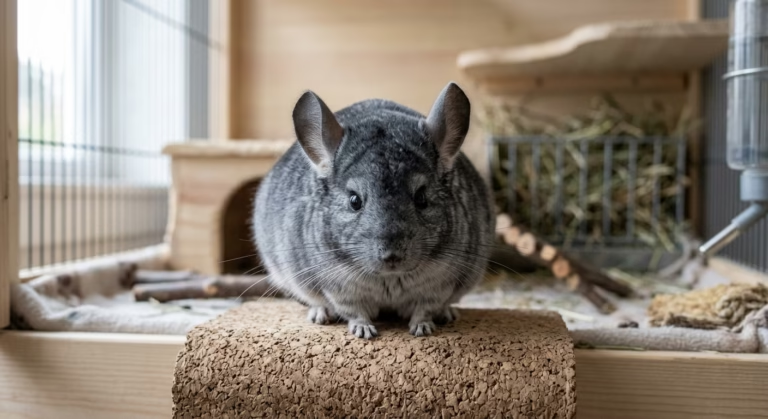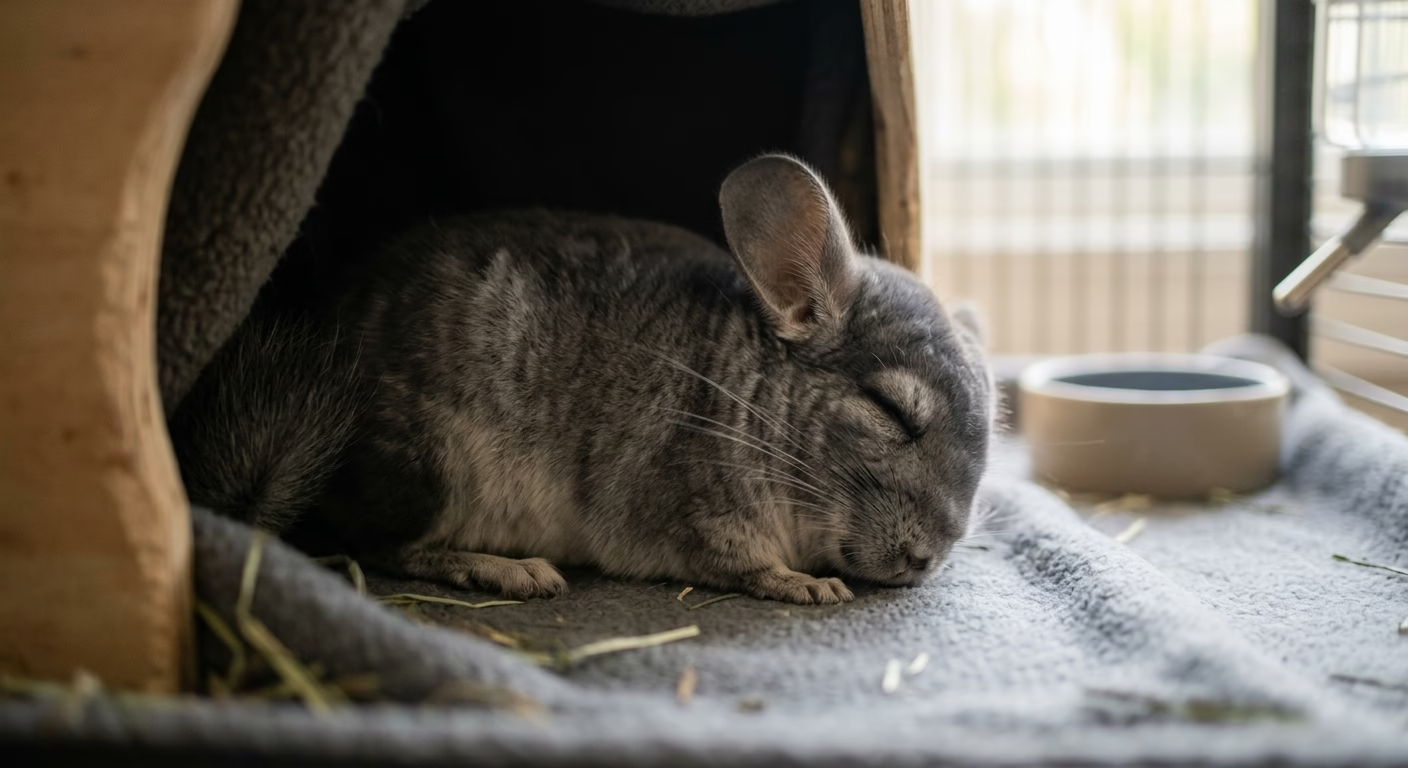
Have you ever watched your chinchilla resting and wondered, “Is my chinchilla sleeping with its eyes open?”
It can certainly look that way. Chinchillas have large, prominent eyes, and their resting posture can make it difficult to tell whether they are fully asleep, lightly resting, or simply awake and still.
The important point is that there is not strong veterinary evidence showing that healthy chinchillas routinely sleep with their eyes open. Current welfare guidance clearly describes chinchillas as daytime sleepers that need long, undisturbed periods of rest, but it does not establish “sleeping with the eyes open” as a normal defining behavior.
If your chinchilla appears to sleep with an eye partly or fully open, look at the whole animal and the eye itself. A one-off observation in an otherwise healthy chinchilla is different from persistent open-eye resting accompanied by wetness, discharge, redness, swelling, squinting, or a change in behavior.
Quick Answer: Do Chinchillas Sleep With Their Eyes Open?
Chinchillas normally sleep during the daytime, usually in a sheltered resting place. RSPCA guidance says they sleep in the daytime and need to be able to rest undisturbed for long periods. It does not describe open-eye sleep as a normal requirement or characteristic.
Older comparative sleep research also shows that chinchillas have organized REM and non-REM sleep and relatively short sleep cycles. One classic dataset reported roughly 12.5 hours of sleep per 24 hours, with average sleep episodes of about 6.5 minutes. That research concerns sleep physiology rather than proving that chinchillas sleep with their eyes open.
So if you see your chinchilla apparently sleeping with an eye open, do not immediately assume that this is either a special adaptation or a sign of illness. Observe the animal and check whether there are any signs of an eye or health problem.
When Do Chinchillas Sleep?
Chinchillas are most active in the evening and at night and sleep mainly during the day. The RSPCA specifically says chinchillas sleep in the daytime and need long periods of undisturbed daytime sleep. Merck also describes them as nocturnal, meaning they sleep much of the day and are active at night.
This is important when interpreting what you see in the cage. A chinchilla that sits very still in a nest box or sheltered area during daylight hours may simply be following its normal activity cycle.
If you want to learn more about suitable sleeping spaces, see our guide to what chinchillas like to sleep in.
What Does Normal Chinchilla Sleep Look Like?
Chinchillas can sleep in surprisingly compact positions. The RSPCA notes that wild chinchillas use rock crevices and holes and that pet chinchillas may sleep squeezed into small spaces. They commonly sleep upright in a huddled position, but can also sleep on their sides or even upside down.
- Huddled upright
- Curled up in a sheltered area
- Lying on the side
- Resting inside a nest box
- Sleeping in another secure, familiar position
The best reference point is your chinchilla’s normal behavior. A position that looks strange to you may be completely normal for that individual.
Why Can It Look Like a Chinchilla Is Sleeping With Its Eyes Open?
There are several reasons an owner might interpret resting as open-eye sleep.
Your chinchilla may simply be resting
Not every period of stillness is deep sleep. A chinchilla can remain quiet in its resting area while still being alert to its surroundings.
The eyelids can be difficult to judge from a distance
Chinchillas have large eyes, so a small change in eyelid position can be difficult to see through cage bars or from across a room.
Your chinchilla may wake easily
Chinchillas are prey animals and can be easily startled by loud or unfamiliar sounds. The RSPCA notes that they have sensitive hearing and can quickly react to unexpected noise.
A chinchilla that looks asleep may therefore become alert quickly when you approach, making it seem as though it was never sleeping.
Is Sleeping With the Eyes Open a Survival Adaptation?
You may see this explanation repeated online: because chinchillas are prey animals, they supposedly keep their eyes open while sleeping so they can watch for predators.
That explanation should be treated cautiously. Chinchillas are certainly prey animals and their natural behavior includes freezing, hiding, and seeking cover when threatened. But that does not establish that routinely sleeping with the eyes open is a documented anti-predator adaptation.
RSPCA guidance instead emphasizes that chinchillas need secure hiding and resting places where they can sleep undisturbed.
This is an important distinction: being adapted to detect danger does not prove that a particular unusual-looking sleep behavior exists for that purpose.
What Does Sleep Research Tell Us About Chinchillas?
Chinchillas have been used in comparative sleep research, so there is scientific evidence that they experience organized sleep rather than simply remaining in a constant state of light rest.
Older electrographic sleep research reported both REM and non-REM sleep in chinchillas and found that their sleep occurred in relatively short bouts. A later comparative analysis of mammalian sleep also lists the chinchilla as a species with a short sleep-cycle duration.
These studies are useful for understanding when and how chinchillas sleep, but they should not be stretched into a claim that chinchillas normally sleep with their eyes open. That specific behavior needs direct evidence, and the veterinary sources reviewed for this article do not establish it as a normal feature.
Should You Worry If Your Chinchilla Sleeps With an Eye Open?
Not necessarily.
If your chinchilla occasionally appears to rest with an eye partly open but is otherwise eating, drinking, moving, grooming, and behaving normally, observe it rather than assuming there is a problem.
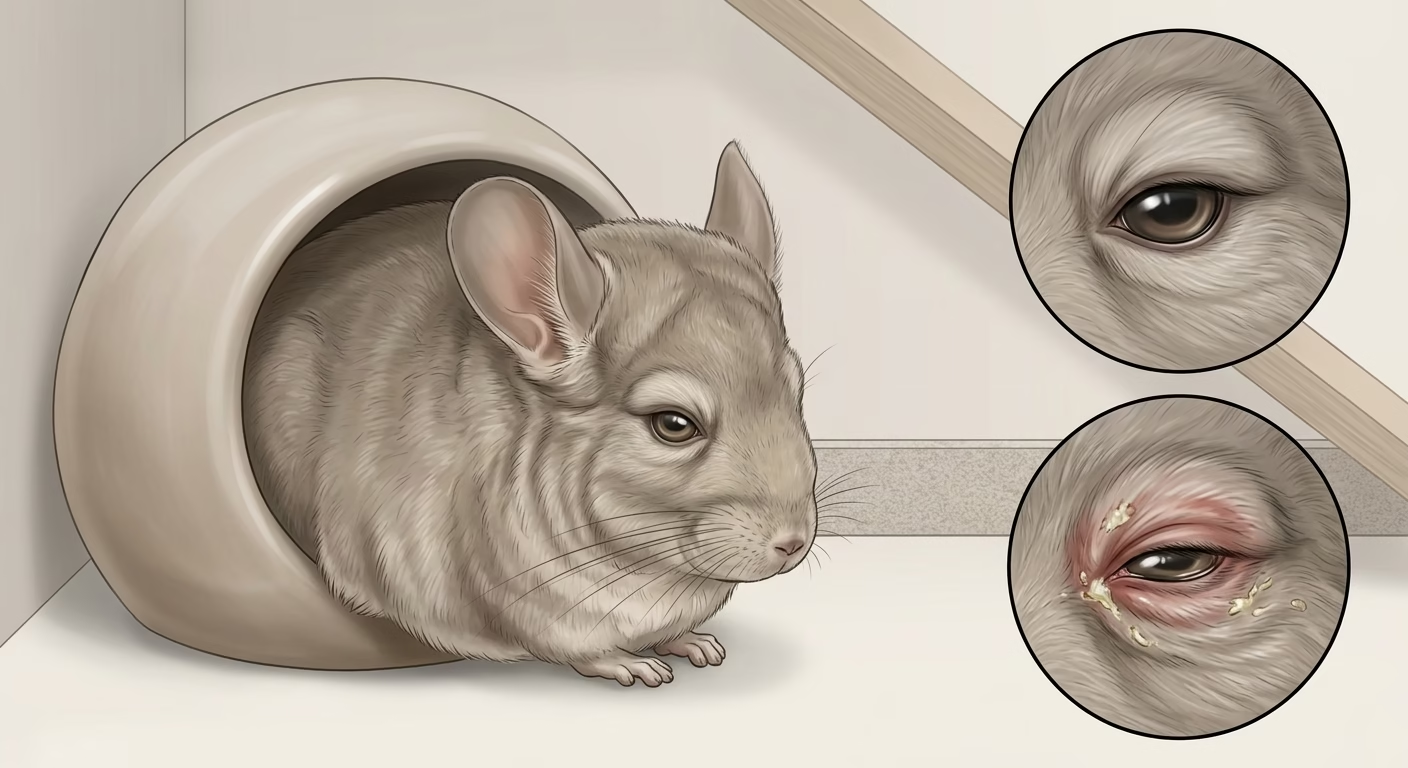
However, persistent changes involving the eye deserve attention. RSPCA health guidance lists wetness around the eyes or mouth among signs that should be taken seriously, and it advises owners to seek veterinary care when they suspect illness, pain, or injury.
Watch for these signs
- Wetness around the eye
- Eye discharge
- Redness or swelling
- Repeated squinting
- Rubbing or pawing at the eye
- A visible change in the eye
- Reduced appetite
- Unusual hiding or lethargy
- Reluctance to move
- A sudden change in normal behavior
If these signs occur, contact an exotic-animal veterinarian rather than trying to diagnose the eye problem from its sleeping position.
Do Chinchillas Need Darkness to Sleep?
Chinchillas need a suitable, predictable environment for daytime rest. The RSPCA says they need to sleep undisturbed for long periods during the daytime and recommends around 12 hours of darkness as part of their care.
That does not mean you need to make the room completely dark at every moment of the day. Instead, provide a quiet, sheltered sleeping area and avoid unnecessarily disturbing your chinchilla during its normal rest period.
For more on this topic, see our article about whether chinchillas live in the dark.
How to Give Your Chinchilla Better Daytime Sleep
You do not need to force your chinchilla to sleep. Your job is to provide an environment in which normal rest is possible.
- Provide a secure resting place: use a suitable nest box or hiding area where your chinchilla can retreat.
- Keep the environment calm: chinchillas can be easily startled by sudden or unfamiliar noises.
- Do not repeatedly wake or handle your chinchilla: daytime is its main rest period.
- Keep the enclosure comfortable: RSPCA guidance recommends a dry, well-ventilated environment and a suitable temperature.
- Watch normal behavior: changes in eating, drinking, droppings, movement, or behavior can be more important than an unusual sleeping posture.
RSPCA guidance also recommends constant access to safe nest boxes and hiding places so chinchillas can rest and escape from things that frighten them.
When Should You Contact a Vet?
A strange-looking sleeping position by itself is not enough to diagnose a health problem. The concern increases when the behavior is new or appears alongside other changes.
Contact an exotic-animal veterinarian if your chinchilla has:
- Persistent eye wetness or discharge
- Redness, swelling, or obvious eye discomfort
- Repeated squinting or rubbing at the eye
- Reduced or absent appetite
- Fewer droppings
- Unusual weakness or lethargy
- Major changes in normal behavior
- Signs of injury or pain
RSPCA guidance specifically recommends veterinary attention when a chinchilla is not eating, is quieter than usual, or shows other signs of illness or pain.
Frequently Asked Questions
Do chinchillas sleep with their eyes open?
There is not strong veterinary evidence that healthy chinchillas routinely sleep with their eyes open. Chinchillas normally sleep during the daytime, and welfare guidance emphasizes providing a quiet, secure place for undisturbed rest.
Why does my chinchilla look like it is sleeping with one eye open?
It may simply be resting or lightly sleeping, and the eyelid position can be difficult to judge. If the eye remains open or looks abnormal and you notice wetness, discharge, redness, squinting, or behavior changes, contact a veterinarian.
Do chinchillas sleep during the day?
Yes. Chinchillas are mainly active in the evening and at night and sleep during the daytime. They should have a quiet place where they can rest undisturbed.
How many hours do chinchillas sleep?
Older laboratory sleep research reported about 12.5 hours of sleep per 24-hour period in the chinchillas studied, with relatively short sleep episodes. Individual pet chinchillas may vary, so avoid treating one number as a required daily target.
Why does my chinchilla sleep in a strange position?
Chinchillas can sleep upright, huddled, on their sides, and in other compact positions. The RSPCA notes that they may even sleep upside down. A familiar unusual posture is not necessarily a problem.
Should I wake my chinchilla during the day?
Generally, no. Chinchillas need long periods of undisturbed daytime sleep. Avoid waking or handling your chinchilla unnecessarily during its normal rest period.
Evidence at a Glance
| Question | What the evidence supports |
|---|---|
| Do chinchillas sleep during the day? | Yes |
| Are chinchillas active at night? | Yes |
| Do they need undisturbed daytime rest? | Yes |
| Do sleep studies show organized REM and non-REM sleep? | Yes |
| Is routine open-eye sleep firmly established as normal? | Not by the veterinary sources reviewed |
| Can unusual eye appearance indicate a problem? | Yes, especially with discharge, wetness, redness, squinting, or behavior changes |
Research & Further Reading
This article distinguishes established chinchilla sleep behavior from claims that are frequently repeated without strong supporting evidence.
- RSPCA — Keeping Chinchillas as Pets
- RSPCA — Chinchilla Behaviour and Welfare
- RSPCA — Chinchilla Health & Welfare Tips
- Merck Veterinary Manual — Description and Physical Characteristics of Chinchillas
- Merck Veterinary Manual — Chinchillas
- PubMed — Reference values for selected ophthalmic diagnostic tests and clinical characteristics of chinchilla eyes
- Comparative research — Energetic constraints and mammalian sleep patterning
Bottom Line
Chinchillas sleep during the daytime, but the claim that they routinely sleep with their eyes open is not well established by the veterinary sources reviewed.
If your chinchilla occasionally looks as though it is sleeping with an eye open, observe the whole animal rather than relying on the eyelid position alone. A normal appetite, normal droppings, normal movement, and normal behavior are reassuring signs.
Persistent eye changes, discharge, wetness, redness, squinting, or other signs of illness are different. In those cases, contact an exotic-animal veterinarian.