Chinchillas and rabbits can live in the same household, but they should not be treated as natural cage-mates. Both are social herbivorous mammals, yet their social communication, housing, behavior and physical needs are different. The safer setup is separate, species-appropriate housing rather than shared housing.
Quick Answer: Can Chinchillas and Rabbits Live Together?
- Same cage: Not recommended.
- Same free-roaming area: Avoid unsupervised contact. If contact occurs, keep it closely supervised and maintain an immediate way to separate them.
- Chinchilla companionship: A compatible chinchilla is the relevant social match, not simply another small herbivore.
- Rabbit companionship: Rabbits have their own species-specific social needs and should be matched with compatible rabbits.
- Same household: Possible, provided each animal has its own secure housing, food, water, hiding places and exercise area.
Current veterinary and welfare guidance emphasizes species-specific housing and social needs. The RSPCA recommends that pet chinchillas live with one or more friendly chinchillas unless a veterinarian or clinical animal behaviourist advises otherwise, while rabbit guidance likewise emphasizes compatibility when rabbits are housed together. citeturn0search4turn0search7
Why Being Social Does Not Mean They Are Compatible
It is easy to assume that two social herbivores should make good companions. Social behavior is species-specific, however. Chinchillas communicate and interact with other chinchillas using vocalizations, body language and other behaviors. Rabbits have their own social signals and relationship patterns.
Merck’s current chinchilla guidance describes chinchillas as social animals with species-specific husbandry requirements. The RSPCA likewise says chinchillas need opportunities for social contact with friendly chinchillas and people. citeturn0search1turn0search8
For rabbits, Merck notes that compatibility is a major factor in group housing and that rabbits may fight seriously when relationships are not compatible. citeturn0search0
Why Shared Housing Can Be Risky
Different communication signals
A chinchilla and a rabbit do not have the same behavioral language. A movement, vocalization or approach that is normal for one species may be confusing or threatening to the other. That makes permanent mixed-species housing difficult to manage safely.
Risk of fighting and injury
Even animals that appear calm can react defensively when frightened, cornered or placed in an unfamiliar social situation. Chinchillas can become aggressive during introductions, and the RSPCA specifically recommends gradual introductions even between chinchillas. Rabbits can also fight when compatibility is poor. citeturn0search4turn0search0
A peaceful first interaction therefore does not prove that permanent cohabitation is safe.
Different housing requirements
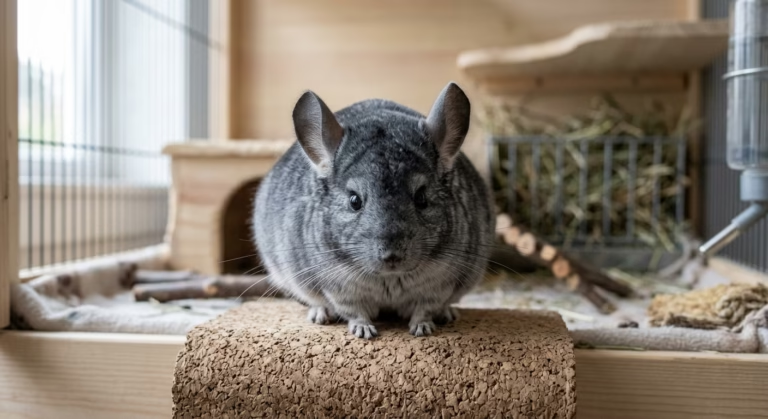
Chinchillas need a large, secure enclosure with multiple levels, climbing opportunities, hiding places and suitable flooring. Merck recommends small mesh openings and solid resting areas, while the RSPCA emphasizes horizontal and vertical exercise space, safe platforms and hiding places. citeturn0search2turn0search10
Rabbits have different enclosure and exercise requirements. Merck recommends safe, enriched housing, daily exercise and sufficient space for rabbits that are housed together. citeturn0search3
Trying to create one enclosure that satisfies both species can therefore compromise the needs of one or both animals.
Temperature and environmental needs
Chinchillas are particularly sensitive to heat. Merck gives an adapted ambient range of about 18.3–26.7°C (65–80°F) and warns that higher temperatures, especially with high humidity, can cause heatstroke. Rabbits also have important temperature and ventilation requirements. citeturn0search1turn0search3
Can a Chinchilla and Rabbit Live in the Same House?
Yes, separate housing can work. There is no requirement for the two animals to share a cage simply because they live in the same home.
Give each animal its own enclosure, food, water, resting areas, hiding places and exercise routine. This allows both species to follow their normal routines without being forced into constant contact.
When either animal is outside its enclosure, prevent accidental access to the other’s space. This is especially important if either animal becomes frightened, territorial or overly excited.
What If They Seem to Like Each Other?
Some individual animals may appear curious or calm around another species. That observation can be useful, but it should not be treated as proof that they should share housing.
Watch for subtle signs of stress instead of waiting for a fight. The RSPCA describes signs such as hiding, barking or whistling, fur chewing, changes in feeding or toileting, reluctance to move and repetitive movements as possible indicators of fear or stress in chinchillas. citeturn0search8
If either animal repeatedly avoids the other, freezes, becomes defensive, chases, lunges or tries to bite, separate them and allow both animals to settle.
What About Supervised Play?
There is little reason to use cross-species play as a substitute for appropriate companionship. Chinchillas can receive exercise and enrichment through a properly designed environment, while rabbits have their own exercise and social needs.
If the animals are ever in the same area, the interaction should be controlled rather than treated as a friendship test. Keep a safe separation option available and end the interaction at the first sign of chasing, lunging, biting, panic or persistent avoidance.
Never force nose-to-nose contact, hold the animals together for photographs, or place them into the same enclosure simply to see what happens.
Can Rabbits and Chinchillas Share Food?
Some foods overlap, especially hay, but their complete diets should not be treated as interchangeable.
Merck states that chinchillas need a high-fiber diet based mainly on good-quality grass hay and that chinchilla-specific pellets should be prioritized, although rabbit or guinea pig pellets have been used successfully in some circumstances. citeturn0search1
So the fact that both species eat hay does not mean they should share complete diets, treats or supplements. Feed each species according to appropriate veterinary guidance.
What Is the Better Social Setup for a Chinchilla?
Chinchillas are naturally social. The RSPCA recommends keeping a pet chinchilla with at least one other friendly chinchilla unless a veterinarian or clinical animal behaviourist advises otherwise. New chinchillas should be introduced gradually because aggression can occur during introductions. citeturn0search4
When multiple chinchillas are housed together, each animal should have adequate access to food, water, hiding places and resting areas. The RSPCA specifically warns that chinchillas can be bullied and need places to escape if they feel threatened. citeturn0search4
What Is the Better Social Setup for a Rabbit?
Rabbits also have species-specific social needs. Merck describes rabbits as social and emphasizes compatibility when rabbits are housed together. Rabbits that are incompatible can fight seriously, so introductions and group housing require careful management. citeturn0search0
That makes another compatible rabbit a more appropriate social match than using a chinchilla as a substitute companion.
If You Already Have Both Animals
- Keep their main housing separate.
- Give each animal its own food and water.
- Provide species-appropriate hiding and resting spaces.
- Prevent unsupervised contact.
- Watch for stress or injury after any interaction.
- Separate immediately if either animal chases, bites, repeatedly avoids the other or shows obvious fear.
If either animal stops eating, becomes unusually quiet, has trouble moving, develops wounds, has breathing difficulty or otherwise behaves abnormally, contact a veterinarian promptly. Merck lists changes such as lethargy, abnormal gait, labored breathing and reduced responsiveness among important signs of illness in chinchillas. citeturn0search1
Frequently Asked Questions
Can a chinchilla and rabbit share the same cage?
No. Shared housing is not a recommended setup. Keep them in separate, species-appropriate enclosures.
Can chinchillas and rabbits play together?
There is no need to use cross-species play as their primary form of enrichment or companionship. If they are ever in the same area, use close supervision and maintain an immediate way to separate them.
Will a rabbit hurt a chinchilla?
Either animal could injure the other during a defensive or stressful interaction. Do not assume that a gentle-looking rabbit or calm chinchilla makes contact automatically safe.
Can rabbits and chinchillas eat the same food?
Some foods overlap, especially hay, but their complete diets should not be treated as interchangeable. Feed each species according to appropriate veterinary guidance.
Should I get a rabbit to keep my chinchilla company?
No. If a chinchilla needs companionship, the relevant social match is another compatible chinchilla, not simply another small herbivorous pet.
Research & Further Reading
- Merck Veterinary Manual — Chinchillas
- Merck Veterinary Manual — Providing a Home for a Chinchilla
- RSPCA — Keeping Chinchillas Together
- RSPCA — Caring for Pet Chinchillas
- Merck Veterinary Manual — Housing of Rabbits
- Merck Veterinary Manual — Providing a Home for a Rabbit
Bottom Line
Chinchillas and rabbits can live in the same household, but they should have separate housing and species-appropriate care. Being social animals does not make two different species interchangeable companions. For a chinchilla, focus on compatible chinchilla companionship, safe enrichment and a low-stress environment; for a rabbit, provide appropriate rabbit companionship and housing.