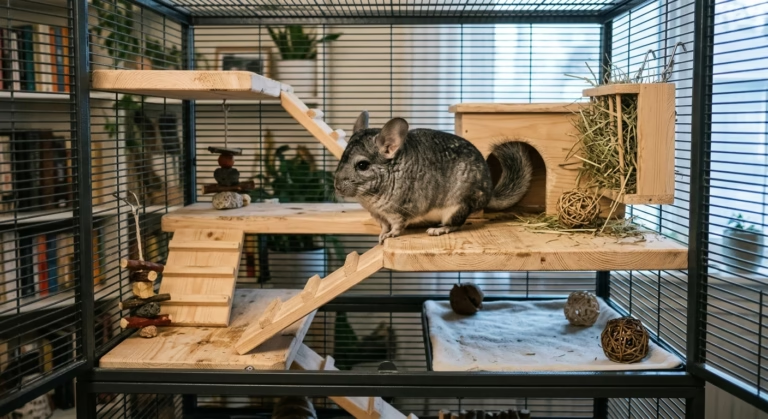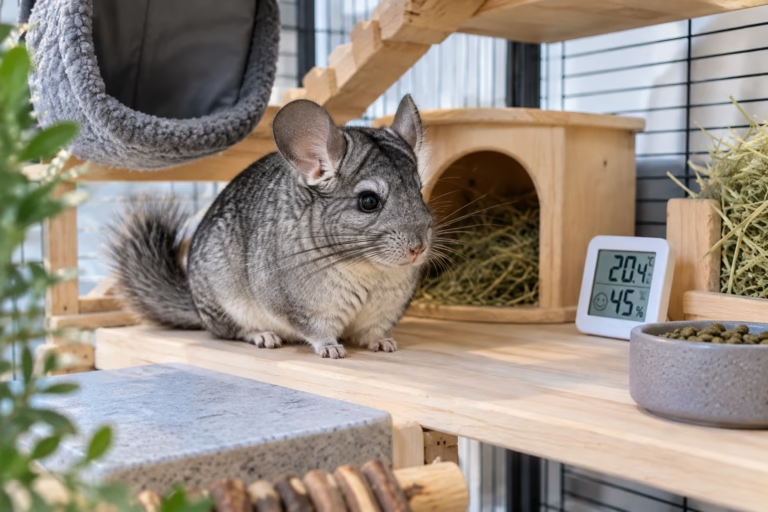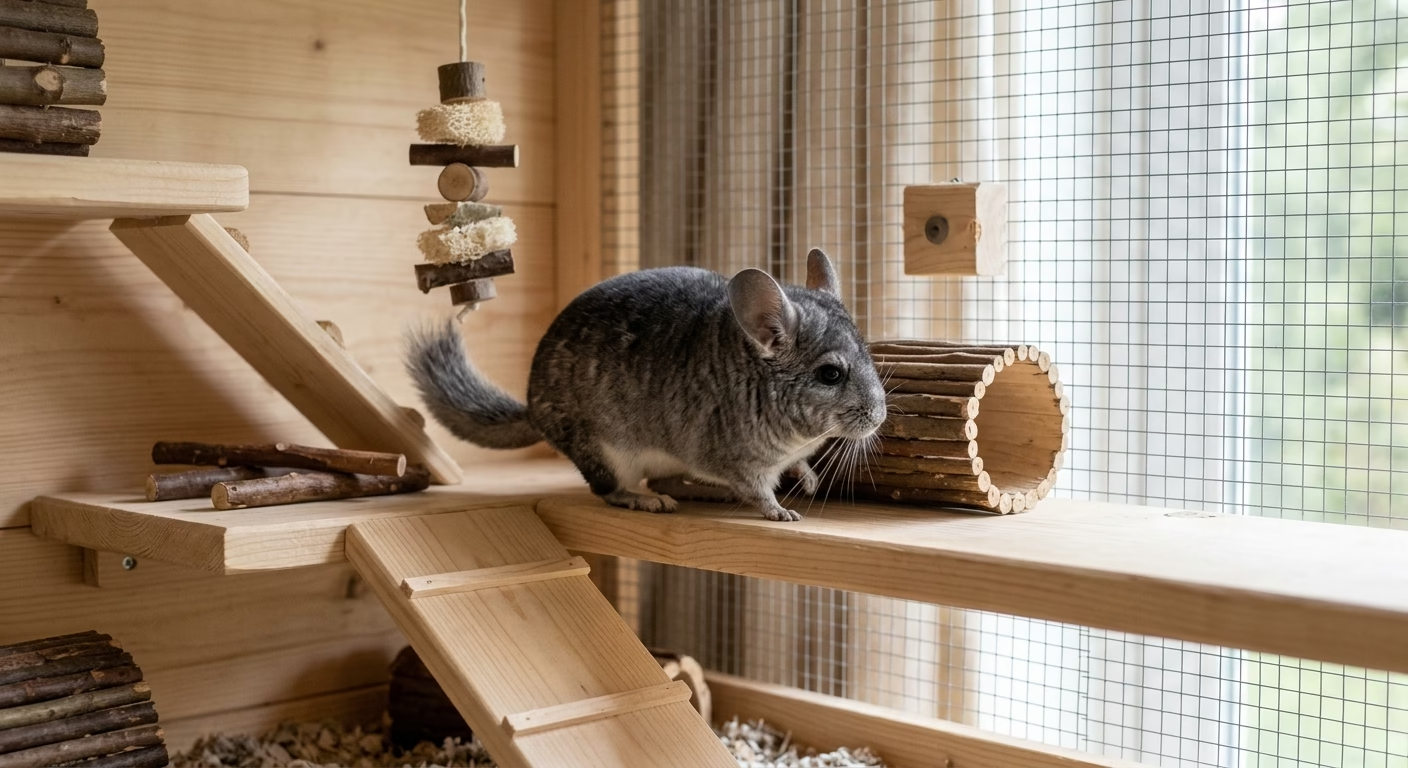
If you search for chinchilla toys, you will find plenty of colorful products claiming to provide enrichment. But for chinchillas, the important question is not simply whether a toy looks entertaining. It is whether the item supports natural behavior while being safe to chew, climb on, or use repeatedly.
Current veterinary and welfare guidance points toward a fairly simple approach: give chinchillas opportunities to chew, climb, jump, explore, hide, and exercise, while avoiding materials and designs that can cause injury or be swallowed. RSPCA guidance specifically recommends wooden, rope, cardboard, and pumice toys for chewing and says to avoid plastic toys. Merck recommends chew toys and wooden toys for activity and mental stimulation.
Quick Answer: What Toys Do Chinchillas Like?
There is no single toy that every chinchilla will prefer. Good options are those that let your chinchilla perform behaviors it naturally uses, especially chewing, climbing, jumping, exploring, hiding, and moving around.
- Safe chew toys: untreated, appropriate wood and other materials recommended for chinchillas.
- Tunnels and hiding places: useful for exploration and security.
- Platforms and branches: provide opportunities to climb and jump.
- Solid-surface exercise wheels: an option for additional exercise when appropriately sized and designed.
- Cardboard enrichment: can provide exploration and chewing, but should be replaced when damaged or soiled.
- Foraging opportunities: can make food access more interesting without relying on sugary treats.
Why Do Chinchillas Need Toys?
“Toys” are really part of a broader enrichment setup. Chinchillas are active, agile animals that need opportunities to move, explore and chew. Merck recommends large cages with multiple levels, ramps and climbing opportunities, while RSPCA guidance recommends exercise space, branches, platforms, hiding places and safe toys. For the wider setup, see our guide to designing a safe chinchilla habitat.
Research on captive chinchillas also suggests that cage complexity and enrichment can affect behavior. In one study of female chinchillas, larger and enriched cages were associated with less fearful or passive responses, although the researchers cautioned that the study design limits how broadly the results can be interpreted.
A 2024 survey of 336 pet chinchilla caretakers found that owners commonly provided structural enrichment such as platforms, houses, tunnels, branches and other furnishings. The study also highlighted that scientific data on pet-chinchilla husbandry are still limited, so enrichment recommendations should not be presented as if every toy has been directly tested in controlled pet-chinchilla trials.
1. Chew Toys
Chewing is one of the most important behaviors to accommodate. Chinchillas’ teeth grow continuously, and Merck recommends unlimited hay as well as wooden blocks to provide chewing and help maintain normal tooth wear.
For toys, the key is safe material rather than a particular brand or shape. RSPCA recommends wooden, rope, cardboard and pumice toys for chinchillas to chew and specifically advises avoiding plastic toys.
- Use products specifically intended to be safe for chinchillas.
- Choose untreated, non-toxic wood rather than painted, chemically treated or pesticide-treated wood.
- Remove toys that develop dangerous splinters, loose pieces or other damage.
- Remember that hay is also important dental enrichment, not just a food source.
Merck notes that untreated wood can be used in chinchilla housing, but any wood should be safe and free from chemicals or pesticides.
2. Tunnels and Hideouts
Tunnels and hiding places are useful because they give a chinchilla somewhere to explore and retreat. RSPCA guidance recommends constant access to safe hiding and resting places, and Merck lists cardboard boxes, wood and PVC pipes as possible hiding structures.
The distinction between a toy and a resting place is not always important. A tunnel can provide both exploration and a secure retreat.
- Make sure openings are large enough for the chinchilla to pass through safely.
- Check regularly for cracks, sharp edges or chew damage.
- Replace cardboard when it becomes heavily chewed, wet or dirty.
- Provide more than one safe place to retreat if your enclosure allows it.
3. Platforms, Branches and Climbing Enrichment
Chinchillas are agile and enjoy moving vertically as well as horizontally. RSPCA recommends branches and solid platforms at different levels so chinchillas can rest and jump. Merck likewise recommends cages with multiple levels, ramps and climbing opportunities.
These features can be more useful than buying a large collection of small toys because they change how the animal uses the entire enclosure.
Safety matters, however. RSPCA recommends avoiding uninterrupted heights greater than 60 cm because falls can cause injury. Platforms should also be stable and positioned so a chinchilla cannot become trapped.
4. Exercise Wheels
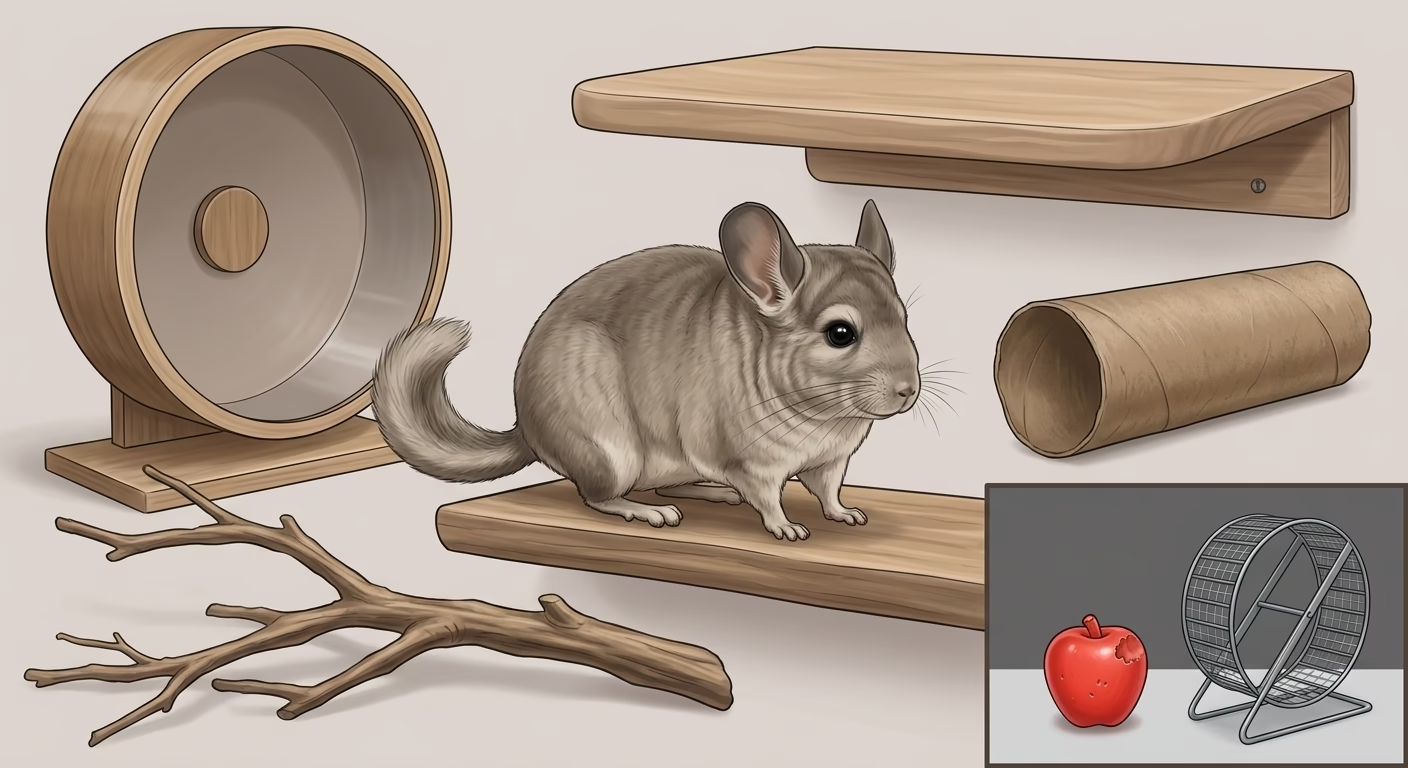
A properly designed exercise wheel can provide additional activity. Merck recommends a 15-inch wheel with a smooth, solid running surface and warns against wheels with holes or rough surfaces because they can injure the feet or legs.
This is an important place to ignore generic rodent-toy advice. A wheel designed for a hamster or other small animal is not automatically appropriate for a chinchilla.
- Use a wheel specifically appropriate for a chinchilla.
- Choose a solid running surface.
- Avoid wire or open-track designs that can catch feet.
- Check the wheel regularly for damage and stable mounting.
VCA also warns that open-track or wire wheels can trap the feet of rodents, including chinchillas.
5. Cardboard and Simple DIY Enrichment
Simple materials can sometimes provide useful enrichment without requiring an expensive commercial toy. RSPCA includes cardboard among the materials chinchillas can chew, while Merck lists cardboard boxes as possible hiding places.
Keep DIY enrichment simple. Avoid anything with staples, glue that can be ingested, plastic coatings, ink-heavy surfaces, strings that can become wrapped around a limb, or small detachable pieces.
Because chinchillas chew their surroundings, a homemade item should be treated as something they may eventually destroy and ingest in small amounts. If it starts breaking into questionable pieces, remove it.
6. Foraging and Food-Based Enrichment
Enrichment does not have to mean adding more treats. You can make normal feeding more interesting by changing how safe foods are presented—for example, encouraging a chinchilla to search through hay or interact with a suitable feeder.
This approach fits the broader principle of environmental enrichment: giving animals opportunities to perform behaviors rather than simply placing more objects in the enclosure. The 2024 pet-chinchilla survey documented activity-feeding enrichment such as food trees or food balls in a portion of surveyed homes, but it did not establish that one particular feeder is necessary for good welfare.
Toys to Avoid
Some products sold for small animals are not appropriate for chinchillas. The safest rule is to judge the material, construction and injury risk rather than assuming a product is safe because it is marketed for rodents.
- Plastic chew toys: RSPCA specifically recommends avoiding plastic toys for chinchillas.
- Wire or open-track wheels: these can catch feet and cause injury.
- Plastic exercise balls: Merck says they are too small for chinchillas and can roll into objects, causing injuries.
- Toys with loose small parts: remove anything that can break off and be swallowed.
- Treated or pesticide-exposed wood: only use wood known to be safe and untreated.
- Damaged toys: replace items when chewing creates sharp edges, loose pieces or other hazards.
How Often Should You Replace Chinchilla Toys?
There is no universal replacement schedule because wear depends on the individual chinchilla and the material. Merck’s care checklist simply advises replacing chew toys as needed.
Inspect toys regularly. Replace them when they become heavily damaged, develop sharp edges, become difficult to clean, or contain loose pieces that could be swallowed.
Do Chinchillas Need Lots of Toys?
Not necessarily. A well-designed enclosure with safe chewing material, climbing opportunities, hiding places and exercise space can provide more useful enrichment than filling the cage with dozens of small objects.
RSPCA guidance focuses on the overall environment: space to run and jump, branches and platforms, hiding places, safe toys and daily exercise.
A Simple Chinchilla Enrichment Setup
| Enrichment | Purpose | Safety focus |
|---|---|---|
| Safe chew toy | Chewing and dental wear | Untreated, appropriate material |
| Solid platforms | Climbing, jumping and resting | Stable; avoid dangerous fall heights |
| Tunnel or hide | Exploration and retreat | No sharp edges or trapping points |
| Suitable exercise wheel | Additional physical activity | Solid surface and appropriate size |
| Cardboard enrichment | Chewing and exploration | Remove when damaged or soiled |
| Foraging activity | Encourages exploration around feeding | Use normal safe foods; avoid unsuitable treats |
Frequently Asked Questions
What is the best toy for a chinchilla?
There is no single best toy for every chinchilla. Safe chew toys, tunnels, climbing structures and suitable exercise equipment can all provide useful enrichment when they are correctly designed and maintained.
What toys are safe for chinchillas?
RSPCA recommends wooden, rope, cardboard and pumice toys for chewing and advises avoiding plastic toys. Any item should also be free from dangerous loose parts, sharp edges and toxic or treated materials.
Can chinchillas have plastic toys?
RSPCA guidance recommends avoiding plastic toys because chinchillas chew and explore objects with their mouths. Choose safer chew materials instead.
Do chinchillas need an exercise wheel?
A wheel can provide additional exercise, but it must be appropriate for chinchillas. Merck recommends a 15-inch wheel with a smooth, solid surface and warns against designs with holes or rough surfaces.
Can chinchillas play with cardboard?
Yes, cardboard can be useful for chewing and hiding, and both RSPCA and Merck include cardboard among suitable enrichment or housing materials. Remove it when it becomes heavily damaged or dirty.
Research & Further Reading
- RSPCA — Creating a Good Home for Chinchillas
- RSPCA — Caring for Pet Chinchillas: Behaviour and Welfare
- Merck Veterinary Manual — Providing a Home for a Chinchilla
- Merck Veterinary Manual — Routine Health Care for Chinchillas
- Merck Veterinary Manual — Chinchilla Care Checklist
- PubMed — Husbandry Conditions and Welfare State of Pet Chinchillas
- Research — Effects of age, size, and cage complexity on chinchilla behaviour
- VCA Animal Hospitals — Rodent Housing and Toy Safety
Bottom Line
The best chinchilla toys are not necessarily the most complicated ones. Focus on safe opportunities to chew, climb, explore, hide and exercise. Wooden and other appropriate chew materials, tunnels, platforms, branches and correctly designed exercise equipment can all contribute to a more stimulating environment.
Most importantly, inspect everything your chinchilla uses. Because chinchillas chew their surroundings, a toy that was safe when new can become unsafe after enough wear. Remove damaged items rather than waiting for a problem.
For chinchilla enrichment, the quality and safety of the environment matter more than the number of toys in the cage.