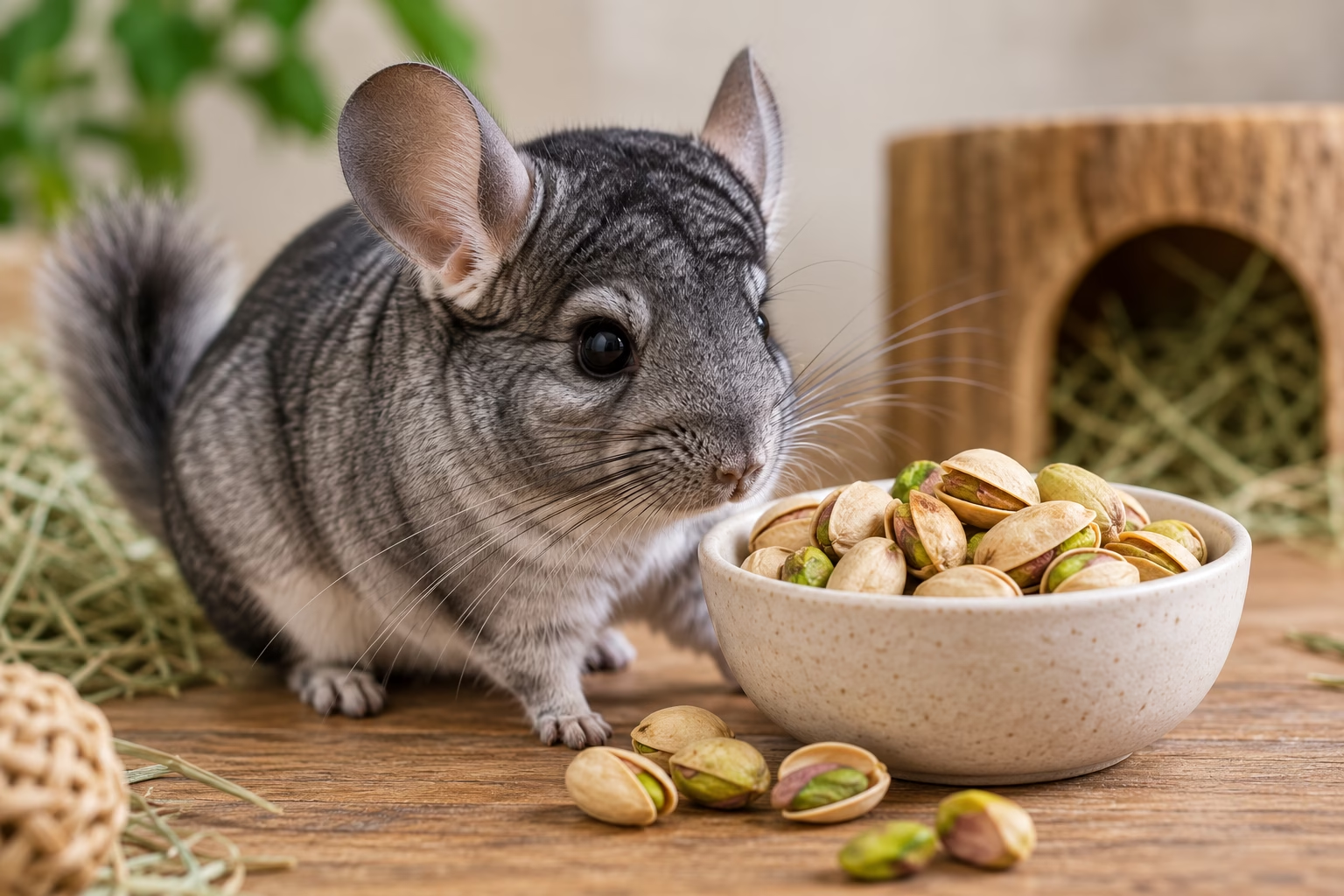
Pistachios may seem like a harmless snack, but they are not a good fit for a chinchilla’s normal diet.
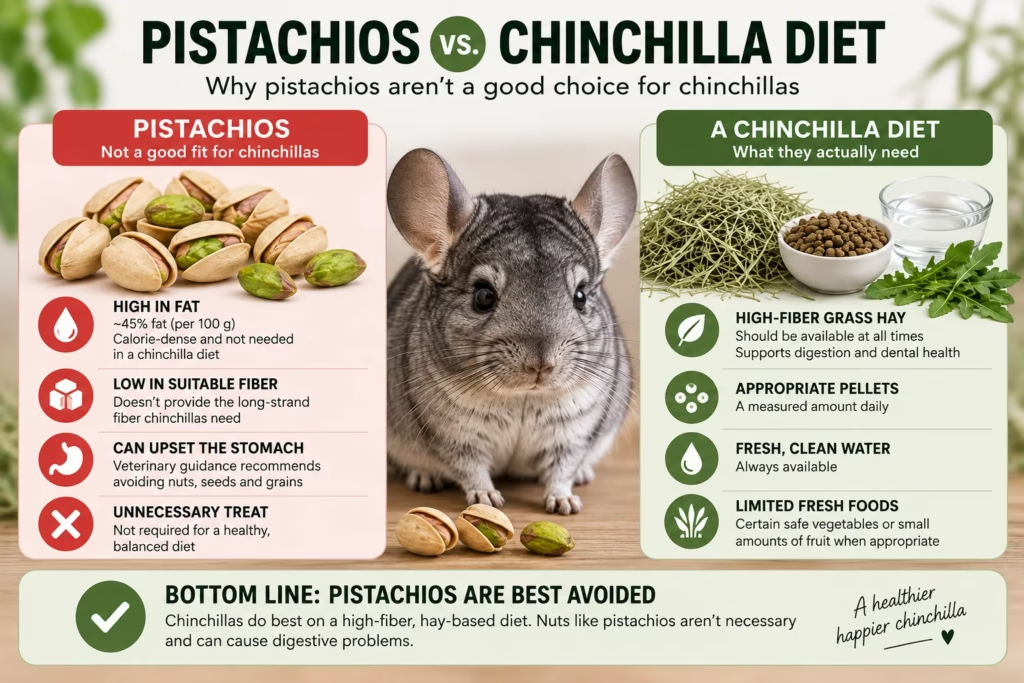
Chinchillas should generally not be fed pistachios. Veterinary guidance emphasizes a high-fiber diet based mainly on grass hay, with appropriate chinchilla pellets and carefully selected fresh foods. Several veterinary sources specifically recommend avoiding nuts because of their fat content and potential to upset the digestive system.
That does not mean pistachios are a proven poison for chinchillas. The concern is that they are an unnecessary, unsuitable food for an animal whose digestive system is adapted to a high-fiber, relatively low-fat diet.
Quick Answer
Can chinchillas eat pistachios?
It is best to avoid feeding pistachios to chinchillas.
Merck Veterinary Manual recommends avoiding nuts, seeds, grains, and dried fruits because they can upset a chinchilla’s stomach. VCA Animal Hospitals also states that chinchillas should never be fed seeds, nuts, or grains. The RSPCA similarly recommends avoiding nuts and seeds because they are high in fat.
There is some variation among veterinary resources. For example, North Carolina State University’s Veterinary Hospital says fruits and nuts can be given as occasional treats in very small quantities, while its broader diet guidance still emphasizes a high-fiber, low-fat diet and recommends pellets without nuts or seeds.
Because pistachios are not nutritionally necessary and several veterinary sources specifically recommend avoiding nuts, there is little reason to include them in a chinchilla’s diet.
Why Are Pistachios a Poor Choice for Chinchillas?
Chinchillas need a high-fiber diet
A chinchilla’s digestive system is designed around a fiber-rich diet.
Grass hay should make up the foundation of the diet. Hay provides the long-strand fiber needed for normal digestion and also gives chinchillas something to chew, which is important because their teeth continue growing throughout life.
Merck Veterinary Manual recommends unlimited timothy hay and a small amount of chinchilla pellets. VCA likewise recommends that grass hay be available around the clock.
This is very different from the nutritional profile of nuts.
Pistachios are relatively high in fat
Pistachios are a calorie-dense nut containing considerably more fat than the foods that should form the foundation of a chinchilla’s diet.
The important point is not that fat is automatically poisonous to chinchillas. Rather, a food that is relatively high in fat does not fit well into a diet designed around high-fiber grass hay.
North Carolina State University’s Veterinary Hospital describes the chinchilla gastrointestinal system as poorly suited to foods high in fat or sugar.
Natural does not automatically mean appropriate
You may see claims that chinchillas can eat nuts because wild chinchillas encounter seeds or other plant materials.
That comparison can be misleading.
A wild animal’s diet is not necessarily equivalent to a controlled captive diet. Pet chinchillas have specific nutritional needs, and veterinary recommendations are generally based on providing those needs rather than simply copying every food that might occur in the wild.
For pet chinchillas, hay should remain the dietary foundation.
Are Pistachios Toxic to Chinchillas?
There is not good evidence that pistachios should be described as a specific poison or toxin for chinchillas.
That distinction matters.
Calling pistachios “toxic” suggests that even a tiny amount is inherently poisonous. The veterinary guidance reviewed for this article does not establish that.
The better-supported concern is dietary suitability.
Nuts are relatively high in fat, and several veterinary sources recommend that chinchillas avoid nuts. A chinchilla’s normal diet should instead emphasize high-fiber grass hay and appropriate chinchilla pellets.
So the more accurate answer is:
Pistachios are best avoided, but they should not automatically be described as a poisonous food.
What Does Veterinary Guidance Say?
Different veterinary organizations do not phrase their recommendations identically, so it is useful to look at the guidance directly.
Merck Veterinary Manual
Merck Veterinary Manual recommends a diet centered on high-fiber grass hay.
Its chinchilla diet guidance specifically says to avoid dried fruits, grains, seeds, and nuts because they can upset a chinchilla’s stomach.
This provides direct support for avoiding pistachios.
VCA Animal Hospitals
VCA recommends a high-fiber diet with grass hay available 24 hours a day.
Its chinchilla feeding guidance specifically states that chinchillas should not be fed seeds, nuts, or grains.
VCA also emphasizes that chinchillas have sensitive digestive tracts and that dietary changes should be introduced gradually.
RSPCA
The RSPCA recommends good-quality hay as the majority of a chinchilla’s diet and grass-based chinchilla pellets as a supplement.
It also specifically recommends avoiding nuts and seeds because they are high in fat.
North Carolina State University Veterinary Hospital
North Carolina State University’s Veterinary Hospital provides somewhat more permissive guidance.
Its chinchilla care page says fruits and nuts may be offered as occasional treats in very small quantities. At the same time, the page describes chinchillas as requiring a high-fiber, low-carbohydrate, low-fat diet and recommends avoiding high-fat treats.
This is an important difference in veterinary guidance.
Rather than claiming that every veterinary source completely prohibits nuts, it is more accurate to say that several major veterinary sources recommend avoiding them, while at least one veterinary hospital allows very small amounts as occasional treats.
For a food that is unnecessary to a chinchilla’s diet, avoiding it is the simpler approach.
But I’ve Seen Websites Say Chinchillas Can Eat Nuts
You may find pet websites, forums, social media posts, or care guides that list nuts as acceptable chinchilla treats.
There are several reasons for this disagreement.
Some information is based on older feeding practices. Other sources may generalize from wild chinchilla diets or list foods without distinguishing between nutritionally appropriate foods and foods that are merely tolerated in tiny quantities.
Veterinary recommendations can also differ in how conservative they are.
For this reason, it is better to look at the underlying diet principles:
- Chinchillas require plenty of fiber.
- Grass hay should form the foundation of the diet.
- Their digestive systems are sensitive to inappropriate foods and sudden dietary changes.
- Nuts are relatively high in fat.
- Pistachios are not required to meet any nutritional need in a properly fed pet chinchilla.
Based on those points, pistachios are an unnecessary treat.
Is There a Safe Serving Size of Pistachios?
There is no well-established, chinchilla-specific pistachio serving size that can be recommended as a standard amount.
This is important because you may see advice online such as “one pistachio is safe” or “give half a pistachio once a week.”
Those precise numbers are often presented without a clear veterinary or research basis.
Because several veterinary sources recommend avoiding nuts altogether, ChinchillaNook does not recommend inventing a pistachio serving size.
If you want to offer a treat, choose an option that is consistent with your veterinarian’s dietary recommendations instead.
What If My Chinchilla Accidentally Ate a Pistachio?
If your chinchilla grabbed a small piece of pistachio, do not automatically assume that an emergency has occurred.
Instead:
- Remove any remaining pistachios from the cage.
- Do not give additional nuts or other unfamiliar treats.
- Return your chinchilla to its normal diet.
- Make sure fresh hay and clean water are available.
- Monitor eating, drinking, droppings, and behavior.
Chinchillas can be sensitive to dietary changes, so monitoring is important.
If your chinchilla stops eating, produces significantly fewer droppings, develops diarrhea, becomes unusually lethargic, appears painful, develops abdominal swelling, or shows breathing difficulty, contact an exotic-animal veterinarian promptly.
What About Salted Pistachios?
Salted pistachios should not be given to chinchillas.
Adding salt, seasoning, oil, flavorings, or other ingredients makes a human snack even less appropriate for a small herbivorous pet.
There is no nutritional reason to give a chinchilla salted pistachios.
What About Unsalted Pistachios?
Unsalted pistachios are still pistachios.
Removing added salt does not change the fact that the food is a relatively fatty nut and is not required in a chinchilla’s diet.
Some veterinary guidance permits nuts in extremely small quantities, but other veterinary sources specifically recommend avoiding them.
For routine feeding, there is no nutritional advantage to choosing unsalted pistachios over an appropriate chinchilla food.
What Should Chinchillas Eat Instead?
Grass hay
High-quality grass hay should be the foundation of a chinchilla’s diet.
Common options include:
- Timothy hay
- Orchard grass hay
- Meadow hay
- Other appropriate grass hays
Hay should be available regularly so your chinchilla can eat and chew throughout the day.
Appropriate chinchilla pellets
A measured amount of a good-quality chinchilla pellet can supplement the hay-based diet.
Veterinary sources commonly recommend a relatively small daily amount for adult chinchillas, but the appropriate quantity can vary depending on the individual animal, age, health, and veterinary advice.
Choose a pellet formulated for chinchillas rather than a mix containing colorful treats, nuts, seeds, or dried fruit.
Fresh water
Clean drinking water should always be available.
Check the water supply regularly and keep the bottle or bowl clean.
Carefully selected fresh foods
Some veterinary sources allow small quantities of suitable fresh vegetables, greens, or certain fruits.
However, fresh foods should not replace the hay-based foundation of the diet.
If your chinchilla has a medical condition or a history of digestive problems, ask an exotic-animal veterinarian before introducing new foods.
Why Hay Matters More Than Treats
It is easy to focus on treats because they are exciting and easy to feed.
For chinchillas, however, the most important foods are much less exciting: hay and an appropriate balanced pellet.
Hay supplies fiber and encourages chewing. Chinchillas also have continuously growing teeth, making appropriate chewing an important part of their daily care.
Merck Veterinary Manual notes that insufficient hay can contribute to dental problems because chinchillas need to chew to wear down their continuously growing teeth.
A pistachio cannot replace those benefits.
When Should You Contact a Veterinarian?
Contact an exotic-animal veterinarian if your chinchilla develops concerning symptoms after eating an unfamiliar food.
Pay particular attention to:
- Loss of appetite
- Significantly fewer or smaller droppings
- No droppings
- Diarrhea or unusually soft stools
- Lethargy
- Abdominal swelling or obvious discomfort
- Excessive salivation
- Difficulty breathing
- Weakness or unusual unresponsiveness
A change in eating or fecal output can be particularly important in chinchillas.
North Carolina State University’s Veterinary Hospital advises contacting a veterinarian promptly when a chinchilla shows signs of illness and states that not eating for more than 12 hours is an emergency.
The Evidence at a Glance
| Question | What the evidence suggests |
|---|---|
| Can chinchillas eat pistachios? | Best avoided as a routine food |
| Are pistachios proven poisonous? | No good evidence supports calling them a specific poison |
| Are nuts recommended by all veterinary sources? | No. Guidance differs |
| Do several veterinary sources recommend avoiding nuts? | Yes |
| Why avoid them? | They are unnecessary and relatively high in fat |
| Is there a proven pistachio serving size? | No established chinchilla-specific amount |
| What should form the dietary foundation? | High-quality grass hay |
| What should owners do after a small accidental bite? | Remove the food, return to the normal diet, and monitor |
Frequently Asked Questions
Can chinchillas eat pistachios?
It is best to avoid feeding pistachios to chinchillas. Several veterinary sources specifically recommend avoiding nuts, while one veterinary hospital provides more permissive guidance for very small amounts.
Are pistachios poisonous to chinchillas?
Pistachios should not automatically be described as poisonous. The stronger concern is that nuts are not a good fit for a chinchilla’s normal high-fiber, low-fat diet.
Can chinchillas eat unsalted pistachios?
Unsalted pistachios are still nuts and are best avoided. Removing salt does not make pistachios a nutritionally necessary food for chinchillas.
Can chinchillas eat salted pistachios?
No. Salted and seasoned pistachios are particularly inappropriate as a pet treat.
How many pistachios can a chinchilla eat?
There is no well-established chinchilla-specific pistachio serving size that should be presented as a standard recommendation.
What if my chinchilla accidentally ate a pistachio?
Remove the remaining pistachios and return your chinchilla to its normal diet. Monitor appetite, droppings, and behavior. Contact a veterinarian if concerning symptoms develop.
What treats are better than pistachios?
Ask your veterinarian which treats are appropriate for your individual chinchilla. Depending on the animal’s health and diet, suitable options may include carefully selected fresh greens or other foods recommended by a veterinarian.
Research & Further Reading
The following veterinary sources were used when preparing this article:
- Merck Veterinary Manual — Diet for a Chinchilla
- VCA Animal Hospitals — Chinchillas: Feeding
- RSPCA — What to Feed a Pet Chinchilla
- NC State Veterinary Hospital — Caring for Your Pet Chinchilla
- Merck Veterinary Manual — Chinchillas
Bottom Line
Pistachios are best avoided as a treat for chinchillas.
They are not a necessary part of a chinchilla’s diet, and several veterinary sources specifically recommend avoiding nuts because of their fat content and potential to cause digestive problems.
There is some variation in veterinary guidance, so it would be inaccurate to claim that pistachios are a proven poison or that every veterinary source completely prohibits nuts.
For everyday feeding, however, the evidence is much clearer about what chinchillas actually need: a high-fiber diet built around quality grass hay, appropriate chinchilla pellets, fresh water, and carefully selected additional foods.
Pistachios simply do not need to be part of that diet.