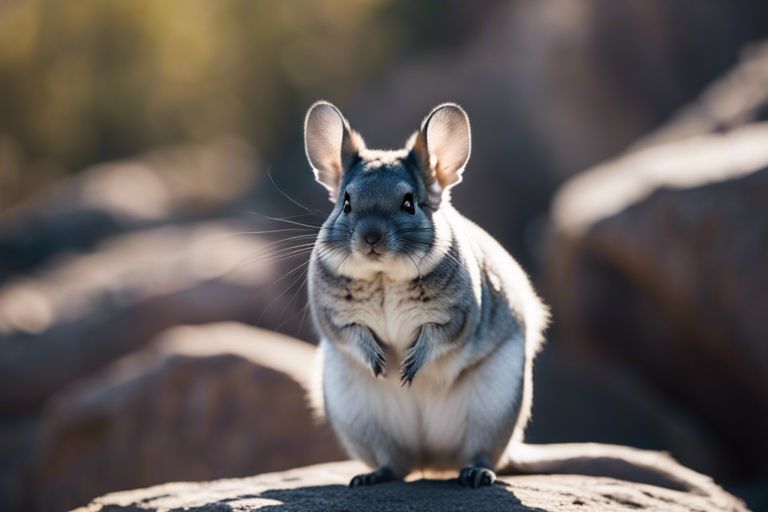
How do chinchillas defend themselves? Chinchillas rely mainly on escape, hiding, agility, and a remarkable defense called fur slip. When threatened, a chinchilla may release a large patch of fur, helping it escape a predator that has grabbed it.
Pet chinchillas still have these natural defensive behaviors, even though they usually do not face wild predators. Understanding them can help you recognize when your chinchilla is frightened or under too much stress.
How Do Chinchillas Defend Themselves in the Wild?
Wild chinchillas live in the high Andes of northern Chile, where they use burrows and rock crevices for shelter. They are well adapted for running and are active throughout the year.
Rather than relying on physical fighting as their main defense, chinchillas are built to avoid danger. Their quick movements, ability to squeeze into sheltered spaces, and dense fur all play a role in surviving threats.
1. Fur Slip Is a Chinchilla’s Most Famous Defense
One of the most unusual chinchilla defenses is called fur slip. If a chinchilla is grabbed, badly frightened, or involved in a fight, it can release a large patch of fur from its skin.
The predator may be left with a mouthful of fur while the chinchilla escapes. Veterinary sources describe fur slip as a natural protective reaction and predator-avoidance mechanism.
The released fur can take several months to grow back, and the new fur may sometimes be a different shade. Fur slip is therefore not something you should try to trigger or reproduce with a pet chinchilla.
2. Chinchillas Use Speed and Agility
Chinchillas have powerful hind legs and are well adapted for moving across rocky terrain. In a dangerous situation, getting away quickly is generally more useful than confronting a predator.
This is one reason a frightened chinchilla may suddenly jump, dash, or try to reach a hiding place. These movements are not necessarily signs of aggression; they can be attempts to create distance from something it considers threatening.
3. Hiding Helps Chinchillas Avoid Danger
Chinchillas are naturally shy animals. In the wild, they use rock crevices and burrows as shelter, and pet chinchillas benefit from having safe places where they can retreat.
A hideout can give a pet chinchilla a sense of security when there are unfamiliar people, loud noises, other animals, or sudden movements nearby.
If your chinchilla frequently runs into its hiding place, give it space rather than pulling it out. Forcing a frightened chinchilla to interact can increase stress.
4. Their Thick Fur Provides Natural Protection
Chinchillas have exceptionally dense fur. Their thick coat provides insulation and also makes it difficult for external parasites such as fleas and lice to live in the coat.
The fur is not a shield against predators, but its density is one of the physical traits that helps chinchillas survive in their natural environment.
5. Chinchillas Can Use Sounds When They Feel Threatened
Chinchillas have a varied vocal repertoire, and some sounds are associated with predator avoidance or defensive and offensive social behavior.
A frightened chinchilla may vocalize, especially when it feels threatened. However, a particular sound should not automatically be interpreted as aggression because chinchilla vocalizations can have different meanings depending on the situation.
For more help understanding sounds, see our guide to what chinchilla sounds mean.
6. Biting Can Happen When a Chinchilla Feels Trapped
Chinchillas generally do not use biting as their first line of defense. They are usually more interested in escaping than fighting.
However, a frightened or stressed chinchilla may bite if it feels trapped or is handled roughly. This is one reason calm handling is important, especially when a chinchilla is still getting used to you.
Learn more in our guide to handling a chinchilla safely.
Do Chinchillas Fight Predators?
Not usually as their main survival strategy. Chinchillas are better equipped to avoid predators by escaping, hiding, and using fur slip if they are physically caught.
A chinchilla can defend itself during social conflict with another chinchilla, and biting or other defensive behaviors can occur. But this should not be confused with a deliberate strategy of attacking predators.
What Should You Do If Your Pet Chinchilla Is Scared?
If your chinchilla appears frightened, the safest response is usually to reduce the source of stress and give it room to calm down.
- Move slowly and avoid sudden movements.
- Reduce loud noises around the cage.
- Give your chinchilla access to a safe hiding place.
- Do not chase it around the cage.
- Never grab it by the fur.
- Handle it gently and support its body properly.
If your chinchilla suddenly develops unusual behavior, lethargy, difficulty moving, breathing problems, or other signs of illness or injury, contact an experienced exotic-animal veterinarian.
Frequently Asked Questions
What is a chinchilla’s main defense?
Chinchillas mainly defend themselves by escaping or hiding. If physically caught, they can use fur slip to release a large patch of fur and potentially escape.
Can chinchillas fight predators?
They can bite or struggle when frightened, but avoiding the predator is generally a more important defense strategy than fighting.
Why does my chinchilla suddenly run away from me?
It may be frightened, startled, or simply trying to avoid being picked up. Give it space and approach calmly rather than chasing it.
Can a chinchilla lose fur when scared?
Yes. A stressed or frightened chinchilla can experience fur slip, especially if it is grabbed, mishandled, fighting, or highly excited.
Final Takeaway
Chinchillas defend themselves mainly by avoiding danger. Their speed, agility, hiding behavior, dense fur, vocalizations, and especially fur slip help them respond to threats. For pet owners, the most important thing is to respect these natural instincts and handle a chinchilla calmly so it does not feel the need to defend itself.