Chinchillas have a more interesting visual system than the usual “they can only see blue and green” explanation suggests.
For years, chinchillas were described as having a pure rod retina, leading to the idea that they could not see color. But a 2019 study published in Veterinary Ophthalmology tested that assumption and found functioning cone photoreceptors in chinchilla retinas. (PubMed)
So, can chinchillas see color?
The best evidence says that their eyes have the photoreceptor machinery needed for color discrimination. However, scientists have not completely mapped the exact range of colors a chinchilla can behaviorally distinguish.
That distinction is important.
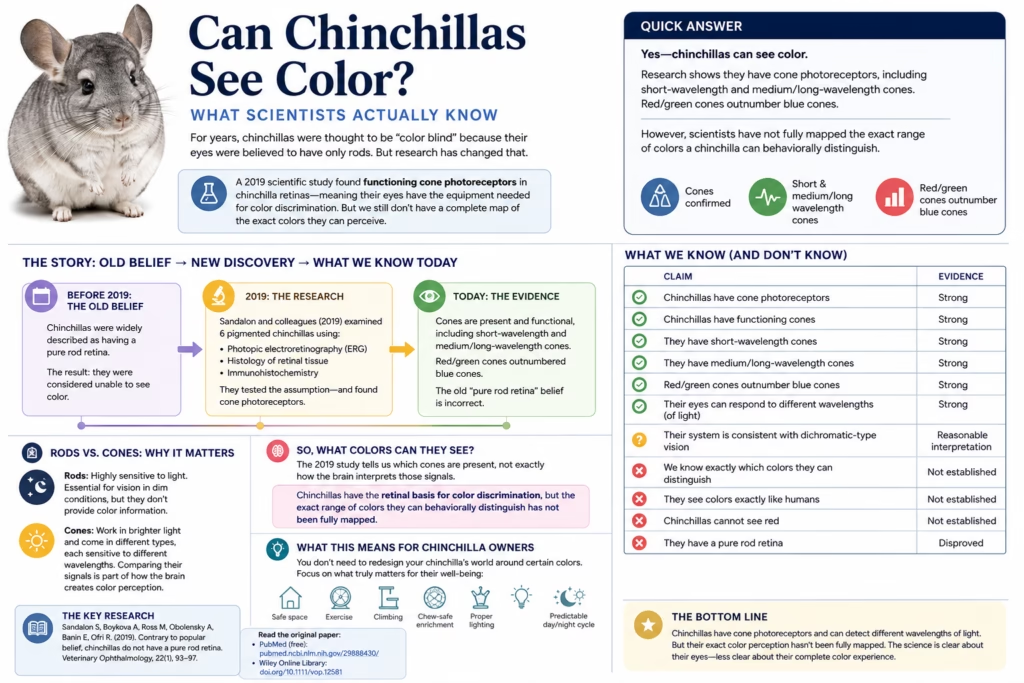
Quick Answer
Chinchillas are not simply color blind.
Research has demonstrated functioning cone photoreceptors in the chinchilla retina, including short-wavelength and medium/long-wavelength cone types. The study also found that red/green cones outnumbered blue cones.
However, this doesn’t mean we can confidently give chinchillas a human-style color chart and say, “They see exactly these colors.”
The precise color experience of a chinchilla has not been fully characterized.
Why Did People Think Chinchillas Couldn’t See Color?
The confusion comes from older descriptions of the chinchilla retina.
Chinchillas were historically described as having a rod-dominated retina, and an older anatomical understanding led to the belief that they lacked cones altogether.
Rods and cones perform different jobs.
Rods
Rods are highly sensitive to light and are especially important for vision under dim conditions.
Cones
Cones operate primarily under brighter conditions and come in different spectral sensitivities. Comparing signals from different cone types is part of how vertebrate visual systems extract information about wavelength and color. (Physiological Reviews)
So if an animal truly had a retina containing only rods, it would not have the normal cone-based mechanism for color vision.
That was the traditional picture of the chinchilla.
Then researchers tested it.
What Did the 2019 Chinchilla Eye Study Find?
The most important research we found is a 2019 paper by Sandalon and colleagues:
“Contrary to popular belief, chinchillas do not have a pure rod retina.”
The researchers examined six pigmented chinchillas.
They used:
- Photopic electroretinography (ERG)
- Histological examination of retinal tissue
- Immunohistochemistry to identify cone photoreceptors
The researchers detected photopic ERG responses and confirmed the presence of cone photoreceptors using immunohistochemistry. They identified short-wavelength and medium/long-wavelength cone photoreceptors. Cone density was higher in the central retina, and red/green cones outnumbered blue cones. (the study’s findings)
Read the original 2019 research paper on PubMed
Read the paper through Wiley Online Library
This is the finding that changes how we should talk about chinchilla color vision.
What Types of Cones Do Chinchillas Have?
The researchers identified short-wavelength and medium/long-wavelength cone photoreceptors.
They also found that:
Red/green cones outnumbered blue cones.
This is important because it tells us that chinchilla retinas aren’t simply equipped with rods and no color-sensitive cones.
But there’s an important limitation.
Having cones isn’t the same thing as having a complete map of color perception.
A photoreceptor tells us what wavelengths of light the eye can respond to. What an animal actually perceives and behaviorally discriminates as different colors also depends on how those signals are processed by the retina and brain.
That’s why we should be cautious about turning the 2019 findings into a simple list of “chinchilla colors.”
Are Chinchillas Dichromatic?
You may see chinchillas described online as dichromatic.
There is a reasonable biological basis for that description: the 2019 study identified two broad cone classes—short-wavelength and medium/long-wavelength cones. A two-cone arrangement is characteristic of dichromatic visual systems in many mammals.
But we’d phrase it carefully:
The available retinal evidence is consistent with a dichromatic-type visual system, but the precise behavioral color discrimination abilities of chinchillas have not been fully characterized.
In other words, we have good evidence about the photoreceptors.
We have less evidence about the complete perceptual experience.
That’s an important difference.
So What Colors Can Chinchillas See?
This is where many online articles become overly confident.
You may encounter statements such as:
“Chinchillas can see blue and green but cannot see red.”
We would not present that as an established scientific fact.
The 2019 study found both short-wavelength and medium/long-wavelength cones, with red/green cones actually outnumbering blue cones.
That doesn’t mean a chinchilla sees red exactly as a human does.
It also doesn’t mean we can confidently say it cannot perceive red.
The most accurate answer is:
Chinchillas have cone photoreceptors sensitive to different parts of the light spectrum, so their visual system has the basis for color discrimination. But the exact range of colors they can behaviorally distinguish has not been fully mapped.
That’s more scientifically defensible than assigning human color names to their entire visual experience.
What About Red?
This deserves its own explanation because it’s one of the most common claims you’ll find online.
❌ “Chinchillas cannot see red.”
We don’t have sufficient evidence to make that categorical statement.
The 2019 study found that red/green cone photoreceptors outnumbered blue cones in the retinas examined. (Sandalon et al., 2019)
But we shouldn’t jump to the opposite extreme and say:
❌ “Chinchillas see red just like humans.”
Their visual system isn’t human vision, and the study did not perform a complete behavioral color-perception experiment.
The responsible conclusion sits between those two claims.
Do Chinchillas Have Good Low-Light Vision?
This is another area where it’s easy to oversimplify.
Chinchillas do have rods as well as cones, and rods are important for vision at low light levels. But the discovery of cones means we should no longer describe their vision as simply a rod-only night-vision system.
There’s also a separate distinction between when chinchillas are active and what their eyes can see.
An animal being active during darker periods doesn’t automatically tell us exactly how its color vision works.
So we shouldn’t use activity patterns alone as proof of a particular type of color vision.
What Does Chinchilla Vision Look Like Compared With Human Vision?
Humans generally have three major cone classes involved in normal trichromatic color vision.
The 2019 chinchilla study identified two broad cone classes rather than the three-cone arrangement typical of human color vision.
That means we shouldn’t expect a chinchilla’s color experience to be identical to ours.
A useful way to think about it is:
Human vision
→ Three major cone classes
→ Trichromatic color vision
Chinchilla retinal evidence
→ Two identified cone classes
→ Color discrimination appears biologically plausible
→ Exact perceptual color range remains incompletely characterized
That’s a much more useful comparison than simply saying that chinchillas “see blue and green.”
What Does This Mean for Chinchilla Owners?
Probably less than some online articles suggest.
You don’t need to redesign your chinchilla’s entire environment around particular colors.
Instead, focus on things that have clearer welfare value:
- Safe opportunities for movement
- Appropriate exercise
- Climbing opportunities
- Chew-safe enrichment
- A secure environment
- Appropriate lighting
- A predictable day/night routine
Color can certainly be part of an enriched environment, but we shouldn’t claim that a particular toy color is scientifically proven to be more stimulating or beneficial to chinchillas unless we have direct evidence for that claim.
That’s an important distinction between reasonable enrichment and unsupported color-vision advice.
What We Know — And What We Don’t
| Claim | Evidence |
|---|---|
| Chinchillas have cone photoreceptors | 🟢 Strong |
| Chinchillas have functioning cones | 🟢 Strong |
| They have short-wavelength cones | 🟢 Strong |
| They have medium/long-wavelength cones | 🟢 Strong |
| Red/green cones outnumber blue cones | 🟢 Strong |
| Their visual system responds to different wavelengths of light | 🟢 Strong |
| Their retinal evidence is consistent with dichromatic-type vision | 🟡 Reasonable interpretation |
| We know exactly which colors a chinchilla can behaviorally distinguish | 🔴 Not established |
| Chinchillas see colors exactly like humans | 🔴 Not established |
| Chinchillas cannot see red | 🔴 Not established |
| Chinchillas have a pure rod retina | 🔴 Disproved |
Why the Old “Color Blind” Explanation Persisted
This is one of the most interesting parts of the story.
The older description of the chinchilla retina helped create a simple narrative:
Rod-dominated retina → no cones → no color vision.
That explanation was repeated for years.
But the 2019 study went back and actually tested the assumption.
The researchers found cone photoreceptors and concluded that the established belief in a pure rod retina was incorrect.
This is a useful lesson in animal science:
A statement can become common knowledge simply because it gets repeated for years. That doesn’t mean the original assumption was ever properly tested.
And that’s exactly why we investigated this question instead of simply rewriting the existing answer.
Frequently Asked Questions
Can chinchillas see color?
Research has demonstrated functioning cone photoreceptors in chinchilla retinas, providing the retinal basis for color discrimination. However, the exact range of colors chinchillas can behaviorally distinguish has not been fully characterized. (PubMed)
Are chinchillas color blind?
Not in the simple sense of having no cone-based visual system. A 2019 study confirmed functioning cone photoreceptors in chinchilla retinas and disproved the idea that their retina is purely rod-based. (Sandalon et al., 2019)
Can chinchillas see red?
We shouldn’t say that chinchillas definitely cannot see red. The 2019 study found medium/long-wavelength cone photoreceptors and reported that red/green cones outnumbered blue cones. However, this does not tell us exactly how a chinchilla subjectively perceives red. (the study’s findings)
Can chinchillas see blue?
Chinchilla retinas contain short-wavelength cone photoreceptors, which are associated with sensitivity to shorter wavelengths of light. The 2019 study confirmed their presence. (the 2019 study)
Are chinchillas dichromatic?
The two identified cone classes make a dichromatic-type visual system a reasonable interpretation of the retinal evidence. However, the complete behavioral color-discrimination abilities of chinchillas have not been fully characterized.
Do chinchillas see colors like humans?
No reason exists to assume they experience color exactly as humans do. Humans have three major cone classes involved in trichromatic color vision, whereas the 2019 chinchilla study identified two broad cone classes. (Sandalon et al., 2019)
Can chinchillas see in the dark?
Chinchillas have rods as well as cones, and rods are important for low-light vision. But “seeing in complete darkness” isn’t literally possible—vision requires some available light. The discovery of cones also means their visual system shouldn’t be described as purely a night-vision system. (the retinal research)
The Bottom Line
Chinchillas have functioning cone photoreceptors and can detect different wavelengths of light.
That means the old claim that chinchillas have a pure rod retina and cannot see color is wrong. (PubMed)
The 2019 research found short-wavelength and medium/long-wavelength cone photoreceptors, with red/green cones outnumbering blue cones.
But there’s still something we shouldn’t pretend to know.
We don’t have a complete behavioral map showing exactly which colors a chinchilla can distinguish and what those colors look like from the animal’s perspective.
So the most accurate answer isn’t:
“Chinchillas see blue and green.”
It’s:
Chinchillas have functioning cone photoreceptors and therefore have the retinal basis for color discrimination, but their exact color perception hasn’t been completely mapped.
At ChinchillaNook, that’s the distinction we’re interested in: what the research actually demonstrates, what we can reasonably infer, and what remains unknown.
Research & Further Reading
🔬 Primary research
Sandalon S, Boykova A, Ross M, Obolensky A, Banin E, Ofri R. (2019).
Contrary to popular belief, chinchillas do not have a pure rod retina.
Veterinary Ophthalmology, 22(1), 93–97.
Read the original research paper on PubMed
Read the paper through Wiley Online Library
🧠 Background on color vision
For a broader explanation of how rods and different cone types contribute to vertebrate color vision:
Read the review on vertebrate color vision